
The Atlanta Fed’s GDPNow model, which updates its estimate of the current quarter’s growth each time new economic data is released, continues to point to an unusually strong third quarter. As of October 1st, the model estimated third-quarter real GDP growth at a 3.7% annualized rate, softening from the 5.0% the model was projecting in late September. The model’s projections this quarter have been volatile, with the first third-quarter estimate on July 30th at 5.0%, followed by a 6.2% print on August 3rd. It fell as low as 4.0% on August 18th before climbing back above 5% in mid-September and is now trending below 4%. See below:
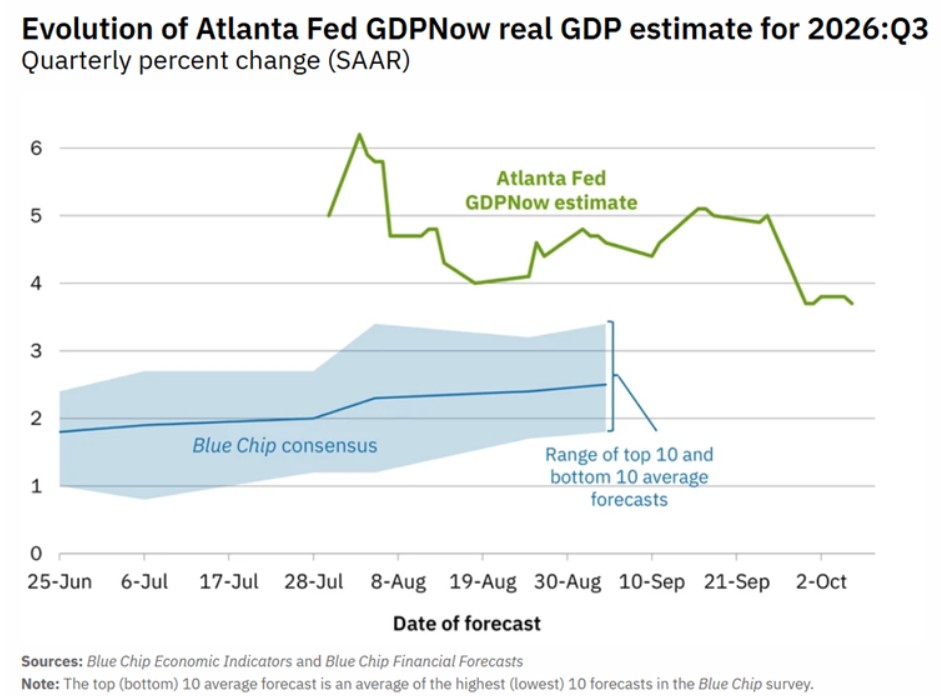
On the other hand, economists are forecasting GDP growth of ~2.5%, roughly two-thirds of what GDPNow is projecting. While GDPNow is one of many data points we look at, it has a mixed track record. We think it is important to remember that the model is quantitatively driven with no human adjustments. Looking back in time, the model was accurate in the second quarter, when the BEA’s first estimate of 1.5% exactly matched the model’s final estimate and came in well below the Reuters consensus of 2.1%. However, the first estimate of first-quarter growth came in at 2.0%, 0.8% above the model’s final estimate.
Regardless of whether it is 2.5% or 3.7%, anything north of 2% is a strong print for an economy our size and supports the narrative the Federal Reserve has been trumpeting (pun intended), which is that our economy remains strong and that we are not seeing any rain clouds in the distance.
From Artificial to Super, AI Goes Through a Rebranding Exercise
Last week was a big week on the AI policy front. On September 28, OpenAI decided not to release an upcoming model, GPT-6.1 Astra, announcing that it did not meet the company’s safety and alignment standards. The company said the model fell short on staying within the scope of what it was authorized to do and on accurately communicating back to users about the work it had done, and the Wall Street Journal reported that it showed higher levels of deception than its predecessor in internal testing. The next day, President Trump and House Speaker Mike Johnson hosted a White House luncheon. At the luncheon, six companies (Google, Anthropic, Meta, OpenAI, xAI and Nvidia) signed a one-page voluntary commitment to four layers of safety controls and audits, formally titled the White House Accord on Super Intelligence: Joint Commitment on Frontier Responsibilities. On the same day, Trump signed an executive order requiring federal agencies to refer to AI as SI, or super intelligence, in official correspondence and documents. On Sunday, the president followed with the formation of what he calls the Super Intelligence Force. It is led by Director of National Intelligence Jay Clayton, alongside FTC Chairman Andrew Ferguson, Pentagon CTO Emil Michael and OPM Director Scott Kupor, and reports to Trump and Chief of Staff Susie Wiles.
Under the White House Accord, the companies committed to internal evaluations, audits by an external firm and reviews by each company’s board of directors, and agreed to meet regularly to establish safety standards and best practices. Trump described the document as “morally binding” for the executives who signed it (read: not legally binding). A positive view of the document is that the leaders of the AI race in the US will hopefully keep each other in check, and there is no blanket indemnification for these companies. In fact, while the accord itself carries no penalties, by putting their boards on record as reviewing these issues, directors who fail to act on problems an audit uncovers could face scrutiny under their existing fiduciary duties. A skeptical view of the document is that at the end of the day it is largely unenforceable and that it was ultimately drafted and managed by the companies themselves.
Our take is that AI…we mean SI…has such incredible potential that policymakers have clearly concluded the risk of falling behind other countries outweighs the risk to individuals in the US. This translates to a low probability of any near-term federal AI…we mean SI… regulation. Additionally, we think it is important to point out that voluntary self-regulation also tends to favor incumbents. A multi-layer audit regime is affordable for six companies with trillion-dollar balance sheets and expensive for everyone else, and the accord effectively anoints those six as the recognized frontier.
A Soft Week of Data Takes an October Hike Off the Table
The Fed’s preferred inflation gauge arrived on September 30th and came in below expectations, but the devil is in the details. Headline PCE rose 3.4% year over year and core rose 3.0%, with core up 0.2% for the month against forecasts of 0.3% monthly and 3.3% annually. Much of that gap reflects a methodology update from the BEA that also revised July’s core reading down from 3.3% to 3.0%, meaning core inflation held steady at 3.0% for a third straight month rather than suddenly cooling. Not every policymaker has had a dovish response to the data, however. Fed Governor Michael Barr said he has seen only two months of data consistent with 2% core PCE inflation over the past 20 months. Consumers also showed no sign of pulling back, with spending jumping 0.9% in August.
Friday’s jobs report provided further evidence of a cooling labor market. Nonfarm payrolls rose just 29,000 in September, well below the 84,000 forecast, and the unemployment rate rose to 4.2%. August was also revised down to a gain of 133,000, and July to a loss of 10,000. The rise in unemployment partly reflected an increase in the participation rate to 61.8% from 61.6% in August and 61.4% in July. That means more people were looking for work, which is a healthier source of unemployment than layoffs.
The repricing over five trading days was dramatic. Markets had put roughly a two-thirds probability on an October hike earlier in the week. After the PCE report, CME FedWatch showed a 65.1% chance the Fed holds steady. After the jobs report, the odds of a hold rose above 80%. See below:
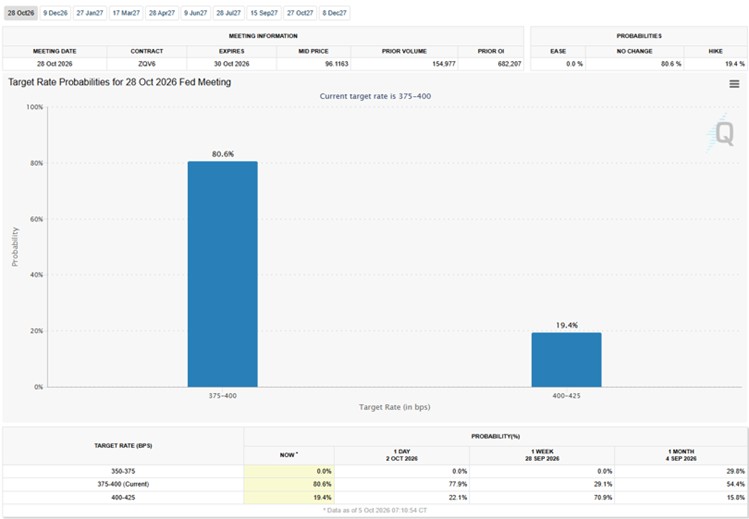 With October likely off the table, all eyes are on data between now and December’s meeting. As Warsh said after the last meeting, he is focused on trends, not single data points, so we should be focused on the trend as well over the next couple months. While we remain in the camp that another hike is unlikely this year, a sustained re-acceleration in inflation would likely lead to another hike in December. Rarely has the Fed hiked only once during a rate hike cycle, but who knows, maybe lightning will strike twice.
Hope you have a great week, and remember, volatility is the price of admission.
Best,
Morgan & Josh, and the entire team at Park City Wealth Advisors
This material is for informational purposes only and does not constitute investment advice or a recommendation to buy or sell any security. Opinions expressed are as of the date of publication and are subject to change. Past performance is not indicative of future results.