


Last Friday’s employment report came in significantly higher, especially after some slower months, revisions, and a very soft July print. Nonfarm payrolls rose 162,000 in August, more than triple the Dow Jones consensus estimate of 53,000, while the unemployment rate held steady at 4.1%. Digging into the numbers, the gains were led by food services and drinking places along with local government education. Beyond the August number, June and July payrolls were revised up by a combined 55,000 jobs.
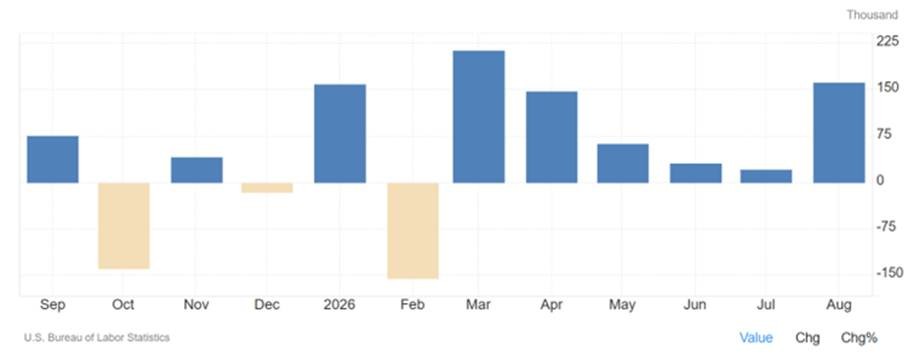
A stronger jobs number combined with stubbornly higher PCE inflation data gives the Fed some wiggle room in terms of potentially hiking. Markets moved slightly on the news. According to CME’s Fed Watch, markets are pricing in 58% probability of a hike. This is significantly higher than was priced in a month ago, but remains below the 67% probability that was priced in a week ago. For a variety of reasons, we remain in the camp of no hike this September, but potentially a hike in December, depending on inflation data.
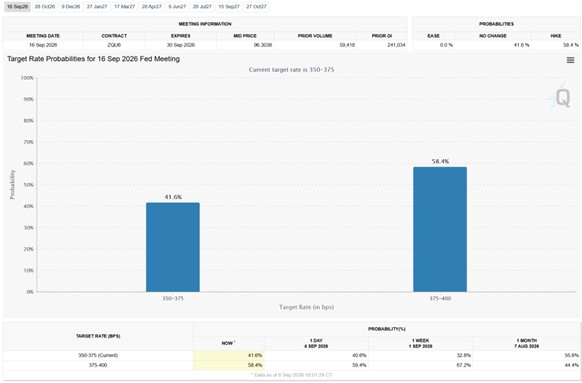
With close to a 50/50 chance either direction, Fed Chair Warsh is keeping the markets on their toes.
Congress Buys Itself Time Until After Midterm Elections to Deal with the Budget
It sometimes feels like Republicans and Democrats cannot agree on much. What they can agree on is that a showdown over government spending and a repeat of last year’s record-setting shutdowns isn’t in the best interest of either party. And it was with that in mind that the House approved a short-term funding measure by a wide 370-48 margin after the Senate had already cleared it, and it heads to the president’s desk for signature ahead of the September 30 fiscal year deadline. The bill also delays a proposed rule that would have given political appointees more authority to withhold federal grants, a change Senate negotiators secured before final passage.
The full-year appropriations fight, including the hundreds of billions in additional military spending Republicans are seeking alongside proposed cuts elsewhere, has been pushed to a December deadline that will land squarely in the middle of election season noise. We think this should help dampen potential volatility during election season as at least this is one less thing the markets and the news cycle will have to worry about.
Forty Trillion and Counting
The national debt crossed $40 trillion in August, a milestone that has been making its way through our news feeds. And it isn’t the sheer amount of debt that is concerning, but also the pace of accumulation. Debt reached $39 trillion in March, meaning the country added a trillion dollars in roughly five months, and interest payments on that debt now exceed $1 trillion annually. The IMF projects debt will reach nearly 126% of GDP this year, up from just over 103% in 2012, with the federal deficit running around 5.8% of GDP, a number we would expect to see during or soon after a recession to support an economy in recovery.
So, what can the US government do? There is no single lever to pull, but we think it is worth walking through some levers:
- Faster economic growth, particularly if AI-driven productivity gains materialize the way the more optimistic forecasts suggest, would grow the denominator in the debt to GDP ratio.
- Spending cuts and tax increases are both viable levers, but reducing a deficit this size would require politically painful changes to entitlement programs or revenue increases well beyond what either party has been willing to put on the table.
- Running inflation higher for longer while trying to keep interest rates lower, effectively growing the assets faster than the liabilities.
- Monetizing the debt, which is where the Federal Reserve buys US debt and allows the US government to continue to function without being dependent on any other groups to buy debt being issued by the US government.
Most likely, we expect Washington to lean on some combination of all of the above rather than a single, one-time fix. While the pace of accumulation of debt is a legitimate, long-term concern, we do not view it as an immediate solvency issue given that roughly three-quarters of it is held domestically. The sad reality is that it will likely take a crisis to force hands in Washington to make material changes.
Hope you have a great week, and remember, volatility is the price of admission.
Best,
Morgan & Josh, and the entire team at Park City Wealth Advisors
This material is for informational purposes only and does not constitute investment advice or a recommendation to buy or sell any security. Opinions expressed are as of the date of publication and are subject to change. Past performance is not indicative of future results.